Disclosure: The Juice Index is reader-supported. If you buy through links on this page, we may earn a commission at no extra cost to you. As an Amazon Associate I earn from qualifying purchases.
A v2l adapter plugs into your EV’s Type 2 charging port and turns it into a live household socket by running the onboard charger in reverse. It won’t power your house. Most cars deliver 2.2 to 3.7 kW, about one wall socket at home. The car burns 390 to 500 watts just keeping that socket alive.
Below I cover what a v2l adapter does, which cars support one, what the ADAC sample found about adapter prices and behaviour, and why vehicle to load suits short, heavy jobs better than a long night on a cool box.
What Is a V2L Adapter?
A V2L adapter plugs into your EV’s Type 2 charging port and turns it into a live household socket, running the onboard charger in reverse.
How does the adapter work?
The onboard charger normally converts AC from the grid into DC for the battery. A V2L adapter reverses that path. Its documentation describes “an external power supply used with an adapter, alongside a socket inside the cabin, with an output of up to 3.6 kW.”
Output specs vary by source and model. One adapter is rated to “safely deliver up to 15A / 250V AC” to household or worksite equipment. Clean Energy Reviews puts V2L output at 10A to 15A, or 2.4kW to 3.6kW. Autonext reports most cars deliver 2.2 to 3.7 kW, “the same as one wall socket at home.”
Not standardised
Adapters differ by brand. Some end in a multi-socket block. Kia’s has a rain hood. Activation varies too. BYD, Kia and Renault use a button on the adapter. MG uses a touchscreen button. BMW and XPeng activate automatically on plug-in.
That matters if you buy a third-party unit. The ADAC tested only manufacturer adapters. Aftermarket accessories from the trade weren’t part of it. If your car’s activation method is unclear, check the manual before buying anything else.
Types of V2L Adapters and What They Cost
Adapters aren’t standardised, and the ADAC sample shows how much the numbers move between cars. The table below uses that sample only. Adapters bought aftermarket weren’t tested.
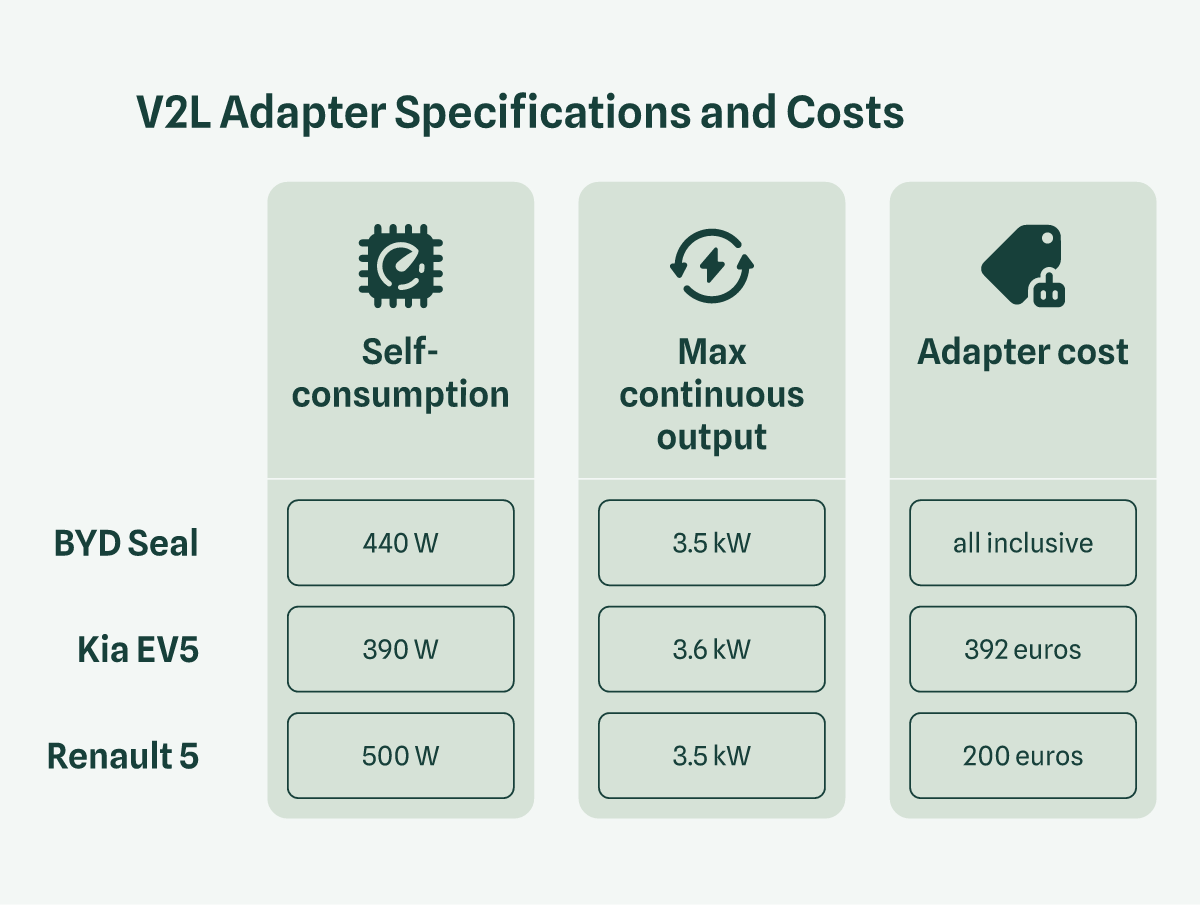
| Model | Self-consumption | Max continuous output | Adapter cost |
|---|---|---|---|
| BYD Seal | 440 W | 3.5 kW | all inclusive |
| Kia EV5 | 390 W | 3.6 kW | 392 euros |
| Renault 5 | 500 W | 3.5 kW | 200 euros |
The price spread is wide. Autonext reports that “in the ADAC sample, prices ran from 120 euros for XPeng to 392 euros for Kia.” On some cars V2L is standard on higher trims, so check your trim before buying anything.
Only the BMW went further. It “ließ 4 bis 5 kW etwa 10 Minuten zu, bevor er abschaltete,” per ADAC, which helps with the inrush current from power tools. That headroom is short lived.
Never stack big loads. Two 2,000 watt devices at once trip every car except, briefly, the BMW.
Inrush response and fault messages vary too. The XPeng G9 was very sensitive to inrush currents, and its overload messages were confusing. The Kia EV5 gave the most concrete fault messages.
Can V2L Power a House?
The direct answer is no. V2L isn’t designed for powering a house or even a large caravan. This function requires a separate vehicle-to-home system and a licensed electrician. I read that V2L functions more like a portable generator or a large inverter. It should never be connected to the electricity grid.
The power limitations are clear. For instance, a continuous 2 kW load will only run for about 31 hours before conversion losses and vehicle consumption drain the battery, according to the data cited in F154. Also, the car consumes a significant amount of power just to keep the socket live. The vehicle burns between 390 and 500 watts just maintaining the connection, according to F46. This hidden cost means every hour the socket is active costs about 2.5 km of driving range before any appliance even draws power, per F48.
My opinion is that you shouldn’t plan on using this for sustained home backup. If you assume you are running a 500 W average load, the power lasts about 123 hours, F154. If you need more consistent power, you are better off looking at dedicated home battery storage rather than expecting your EV to act as a full household power source.
How to Choose a V2L Adapter
Confirm your car and trim first
Not every EV supports V2L, and the adapter is often extra rather than included. In the ADAC sample, adapter prices ran from 120 euros for the XPeng G9 to 392 euros for the Kia EV5. Check your exact model and trim before you buy anything. On some cars V2L is standard only on higher trims, so the same model name can hide two very different answers.
Match the activation method
V2L adapters aren’t standardised. Some end in a twin-socket 10A powerboard outlet, and activation differs by brand. BYD, Kia and Renault use a button on the adapter. MG uses a touchscreen control. BMW and XPeng activate automatically once plugged in. Buy the adapter that matches your car’s own method, or you’ll be pressing a button that does nothing.
Size loads below the ceiling
For extended use, don’t run the adapter at its limit. Clean Energy Reviews recommends staying under 80 to 90 percent of the power rating in warm weather. On a car rated 3.6 kW, that’s roughly 3.0 kW. One source suggests setting an Ioniq 5 or EV6 to 3.0 kW to avoid stressing the inverter.
Set a floor and keep it dry
Set a battery floor so you can still drive home. One source notes the donor car stops at 20 percent on Hyundai and Kia. Never use V2L in the rain. No manufacturer gives a rain approval, even though the adapters are built for outdoor use.
What You Can Actually Run
Most cars deliver 2.2 to 3.7 kW, enough for a coffee machine or power tools. That’s roughly one household wall socket, so treat the V2L adapter as a single outlet you can move around. It won’t run a whole building.
The catch is the overhead. The car burns up to 500 watts keeping the socket on, whatever you plug in. V2L suits short, heavy jobs best for that reason.
The self-consumption problem
Add up what you want to run before you plug anything in. A laptop at 40 W, a light at 60 W, a screen at 120 W, a fridge at 140 W and a 2,200 W kettle gives 40+60+120+140+2200 = 2,560 W, or 2.56 kW. That sits under a 3.6 kW car, but two 2,000 W devices at once trip every car in the ADAC sample except, briefly, the BMW.
Self-consumption alone drains the pack. A 60 kWh battery at 450 W could hold V2L active for about five and a half days before the battery is empty, and nothing has been powered yet.
Small loads are the trap
A 50 W cool box is tolerable for a while, but very inefficient in continuous operation. I wouldn’t run one off the car for a weekend. A 500 Wh power bank is the cheaper option in range for that job, and it doesn’t tie up the vehicle.
FAQ
What does a V2L adapter do?
A V2L adapter turns your car’s Type 2 charging port into a household socket. Plug it into the charging inlet and you get a normal Schuko outlet at the other end. Hyundai rates the system at 230V / 50 Hz, up to a maximum of 3.6kW, or 15 Amps. The adapter doesn’t generate power. It lets the onboard charger run in reverse and pull current from the drive battery. On most cars you’ll see around 3.6 kW, same as one wall socket at home. Activation varies. BMW and XPeng start it automatically. BYD, Kia and Renault need a button press on the adapter, and MG uses a touchscreen control.
Can V2L power a house?
No. V2L isn’t built for a house. Hyundai’s own guidance says you should never connect V2L to the electricity grid, domestic or work, and that it works like a portable generator or large inverter, not as home battery storage. The output is the reason. Most passenger-car V2L systems provide roughly 2.3 to 3.6 kW. An efficient off-grid house uses 10 to 15kWh per day. Powering a home needs vehicle-to-home hardware and an electrician. If this were my call, I would treat V2L as a socket for appliances, not a backup supply for a building. The common advice to “just run an extension lead into the house” is wrong.
Can any EV do V2L?
No. V2L is model-specific and often trim-specific. In the ADAC sample, V2L was standard on the Kia EV5 in higher trims, and standard on the MG4, Renault 5 and XPeng G9. The adapter is usually extra. ADAC found adapter prices ran from 120 euros for XPeng to 392 euros for Kia. Some cars also add a second socket inside the cabin that shares the same power. Check your own model and trim before assuming anything. I would confirm V2L is listed for your exact car rather than trusting a brand-level claim, because the feature can appear on one variant and not the next.
Vehicle to Load (V2L) adaptors experience?
Adapters aren’t standardized, so your experience depends on the brand. Some end in a multi-socket block, and Kia’s has a rain hood. Activation varies too. BYD, Kia and Renault use a button on the adapter, MG uses a touchscreen, and BMW and XPeng switch on automatically. ADAC found real gaps. Not every maker locks the adapter once it’s connected, and on some cars you can pull it out while it’s live. Error messages were sometimes misleading, including “check OBC” when the onboard charger had no fault. No manufacturer approved operation in rain, even though the adapters are meant for outdoor use. I would read your manual before the first use.
What do you use V2L for?
Short, heavy jobs suit V2L best. Most cars deliver 2.2 to 3.7 kW, enough for a coffee machine or power tools. The catch is the standby draw. ADAC measured an idle consumption of 390 to 500 watts across all tested cars, and Autonext notes the car burns up to 500 watts keeping the socket on. That makes long, light loads inefficient. For a 50 watt cool box over a weekend, a 500 Wh power bank is the cheaper option in range. I would skip V2L for anything running unattended for days. Use it for a kettle, a tool, or a charger, then switch it off.
Sources
- Elektroauto als Powerbank: Ist Vehicle-to-Load sicher?
- E-Autos als mobile Stromversorgung
- V2L: run a coffee machine or power tools from your EV
- Vehicle-to-load Explained - V2L for off-grid or backup power - Clean Energy Reviews
- V2L ADAPTER VEHICLE-TO-LOAD POWER
- Hyundai IONIQ 5 V2L
- V2L charging: Can you use your car to power your home during blackouts?
- Understanding the V2L Adapter: Meaning and Compatibility