Disclosure: The Juice Index is reader-supported. If you buy through links on this page, we may earn a commission at no extra cost to you. As an Amazon Associate I earn from qualifying purchases.
You can charge an EV from a NEMA 14-50 outlet at home and at plenty of RV parks. The NEMA 14-50 is a 240-volt, 50-amp outlet, and Camp and Charge calls it the one outlet you want at a campground pedestal (F1, F17). It’s an outlet, not a connector, so a nema 14-50 ev charger is really a portable EVSE that plugs in and lets the car pull up to 40 amps. The guide covers outlet types, park policies, charger picks, and the safety details that trip people up.
Is a NEMA 14-50 Safe for EV Charging? (Direct Answer)
Yes, I consider the NEMA 14-50 safe for EV charging under specific conditions. This is a 240-volt, 50-amp outlet, and I find it to be the only campground outlet we are comfortable recommending for EV charging (F17, F34). It delivers 240 volts and charges your EV about as fast as a Level 2 home charger (F2).
Power Limitations and Speed
The outlet itself is rated for 50 amps. Based on the NEC continuous use rule, it supplies up to 40 amps continuously (F230). That’s enough to add meaningful range overnight. The car’s onboard charger and the portable EVSE still set the real charging rate (F74). Don’t treat this outlet as a DC fast charger. It’s AC Level 2 charging using your own equipment (F62, F67).
Physical Installation Notes
The NEMA 14-50 is a four-prong outlet, which includes one ground and three straight slots. Matching the receptacle as installed is key to functionality, whether it’s ground up or ground down (F17).
My take is that while the outlet is safe when paired with a portable charger, relying on a park’s infrastructure without checking amperage draw is a recipe for a tripped breaker.
Options and Methods: Home Outlet, Portable Charger, RV Park Pedestal
The NEMA 14-50 standard socket is US-based and most commonly used for charging electric vehicles, according to EV Adept. It’s also often used for RV and mobile homes, so the same outlet type covers three situations.
Home Outlet
A plug-in charger stays mobile. Unplug it, stow it in the trunk, and use it at an RV park. Hardwiring locks it to one wall. Smart Home Explorer notes that a plug-in unit needs no permit and no call to an electrician. If the charger fails under warranty, you unplug it and send it back yourself.
RV Park Pedestal
At RV parks, you want the 50-amp outlet (NEMA 14-50), per Camp and Charge. You’ll also see a 30-amp TT-30, but that guide says “we don’t recommend using it for EV charging due to safety concerns.” Check the park’s policy before you plan the stop.
Skip the 14-50 to 5-15 Adapter
I would still skip it. You drop from 240 volts to a 120-volt trickle rate. You also add an adapter joint that can fail under load. Pack your Level 1 charger instead. Camp and Charge lists it as a backup “for parks that only have standard outlets or 30-amp TT-30 service.” That way the park’s outlet matches the plug you brought.
Costs and Trade-offs Table
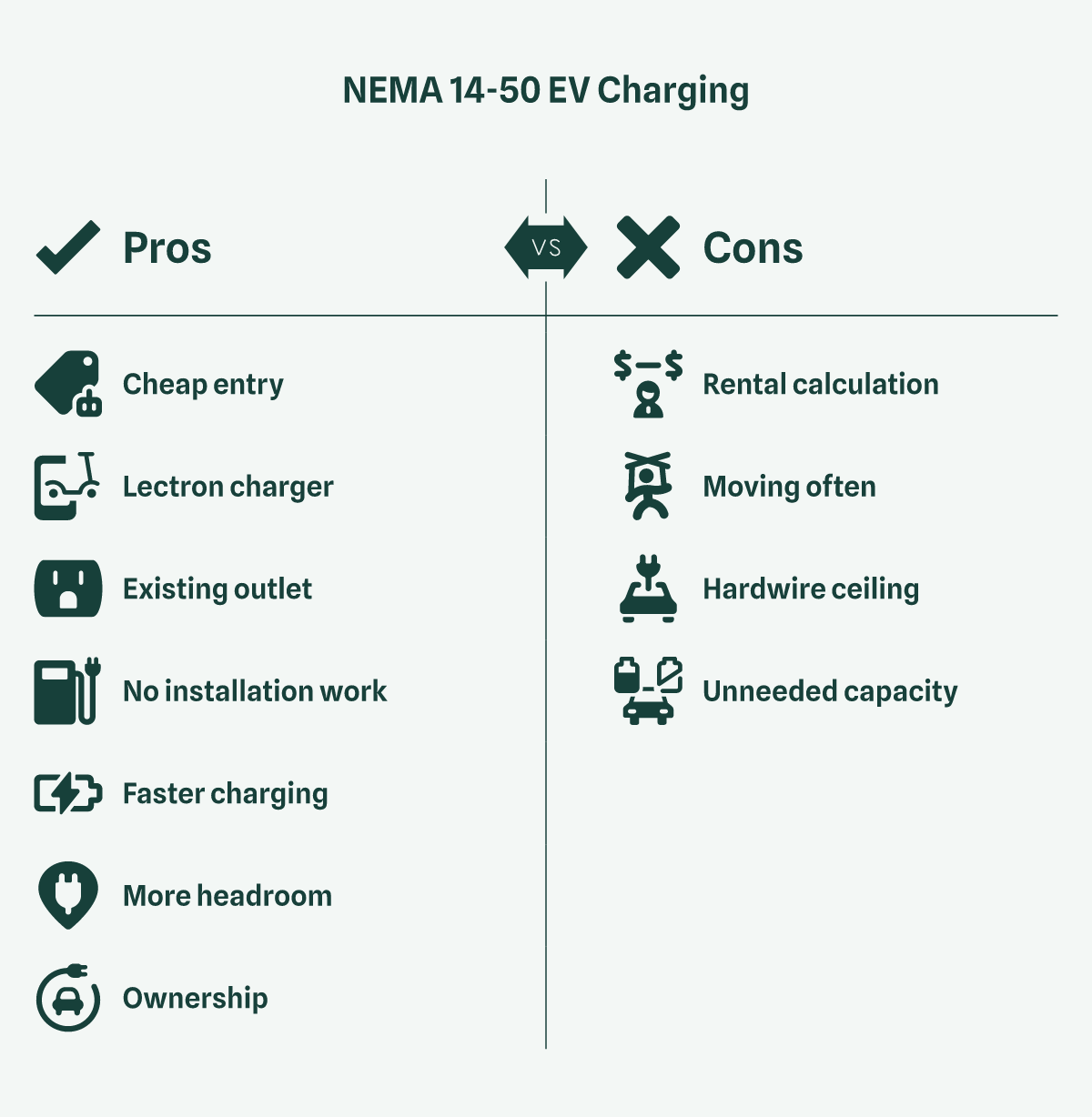
The plug-in end of this market is cheap to enter. The Lectron NEMA 14-50 Level 2 EV Charger (40A) wins for most buyers, per Smart Home Explorer, which cites full 9.6 kW speed, a carrying case and adjustable amperage with zero hardwiring. If your outlet already exists, nothing else is required. No permit, no electrician, no wall work.
Speed: 14-50 vs 14-30
EV Adept states the NEMA 14-50 charger provides a faster charge than the 14-30 charger, and puts the gap at 9.6 kW against 5.8 kW. At 9.6 kW you replace it in under two hours. At 5.8 kW you need a bit over two hours. Both work. The 14-50 just leaves more headroom.
Public Station Pricing
Networks set their own tariffs, and some add a session or idle fee. Median pricing on a small sample isn’t a budget you can bank on.
Own vs Rent
EV Adept’s advice is blunt: do the math on monthly rental charges versus what it would cost to own your own NEMA 14-50 charging station over a certain period. My read is that anyone with a driveway and a spare 240-volt circuit should own. The rental math only wins if you move often.
The Hardwire Ceiling
A 48A (11.5 kW) ceiling or a permanently wired charger puts you in a different product class than the plug-in 14-50 units, as Smart Home Explorer notes. Plenty of drivers never need it.
Recommendations by Situation
You Have an Existing NEMA 14-50 Outlet
Got a NEMA 14-50 outlet already installed and you absolutely refuse to call an electrician? I would start with the Lectron NEMA 14-50 40A unit. It earns a 9.1 on the weighted SHE Plug-and-Go Score. You get full charging speed, a carrying case and adjustable amperage, all without a permit or a service call. This portable option lets you use the 240V power without permanent installation.
Deciding Between Plug-In and Hardwiring
Think about mobility when you’re installing a new setup. A plug-in 14-50 charger keeps your equipment mobile and swappable if it fails under warranty. That’s the benefit of a plug-in device over hardwiring. Want the full 48A ceiling? Hardwiring the connection is the only way to access that higher power level.
When Traveling at an RV Park
Bring a portable Level 2 EVSE when you travel to an RV park. The NEMA 14-50 outlet is the one you want at the campground. It delivers 240 volts and will charge your EV about as fast as a Level 2 home charger. A NEMA 14-50 listing is just an outlet, so check the access notes and bring the right cable.
FAQ
Is NEMA 14/50 safe for EV charging?
Yes, when the circuit and the outlet are rated for continuous draw. The NEMA 14-50 is a 240-volt, 50-amp outlet, per Camp and Charge, and it’s the only campground outlet that guide is comfortable recommending for EV charging. The outlet itself isn’t the weak point. Loose terminations, worn receptacles and undersized wiring are the failure points. A NEMA 14-50R receptacle in a metal enclosure is built for high-power applications such as EV charging or RV hookups and meets NEMA standards for safe residential or commercial installations, per ORTECH Industries. If a camp host or park owner tells you which outlet to use, listen to them.
What is a NEMA 14-50 charger?
A NEMA 14-50 isn’t a charger. It’s a 240-volt outlet, per EVDIR. The charger is the portable EVSE you plug into it. When a station lists NEMA 14-50, it expects you to bring your own equipment and plug in. The outlet has the same four-pin shape many RVs and ranges use. At 50 A it can supply up to 40 A continuously, though the car’s onboard charger and the portable EVSE still set the real rate. Don’t treat a NEMA 14-50 outlet as a DC fast charger.
Can I install a Nema 14-50 outlet myself?
I wouldn’t. A 14-50 circuit is a 240-volt branch circuit. The common advice that a confident DIYer can handle it skips the part that matters: torque on the terminations and the breaker and wire sizing for a continuous load. Loose terminations are what burn receptacles. If you already hired an electrician, keep the appointment. The one judgment call worth making is hardwire versus outlet. A hardwired connection removes the plug-and-receptacle interface entirely. That interface is where most of the horror stories start. If this were my call, I would hardwire a wall unit and keep a portable 14-50 charger for travel.
Is this a good NEMA 14-50R for EV charging at 40A?
A 14-50R rated 50A at 125/250V in a metal enclosure is the right class of receptacle for a 40A continuous EV load. ORTECH’s EV-14-50-R is exactly that: a NEMA Type 14-50R, 50A 125/250V receptacle in a metal enclosure, designed for high-power applications such as EV charging or RV hookups. The 40A figure comes from the 80% continuous-duty rule. It doesn’t come from the receptacle’s rating. EV Adept notes that the NEMA 14-50 standard specifies a maximum current of 50A, but under the NEC only 80% is allowed for continuous use. So even a charger labeled 50A won’t produce more than 40A for an EV. Buy a receptacle rated for the full 50A.
What went wrong with this burned Nema 14-50?
A burned 14-50 is almost always a connection problem. It’s rarely a voltage problem. Heat builds at a high-resistance point: a loose terminal screw, a receptacle that has lost its grip after many plug cycles, or a plug that wasn’t fully seated. Continuous draw makes it worse because the load runs for hours without a cooldown. Prevention is the fix. Have the terminations torqued to spec. Replace a worn receptacle instead of reusing it. Check the plug for warmth the first few times you charge. If a park outlet looks scorched or loose, don’t use it. Ask the park for another site.
Sources
- Can You Plug an EV Into an RV Outlet? | Camp and Charge
- NEMA 14-50 EV charging stations: 174 in the US · EVDIR
- 5 Best NEMA 14-50 EV Chargers 🔌 Tested and Reviewed • Epic Buyer’s Guide • EV Adept
- RAB_2025_06_Spec Sheet_POB-RVEV_EN_2.0
- Best Portable Level 2 EV Chargers (NEMA 14-50 Plug-In) for 2026
- EV-14-50-R – ORTECH Industries Ltd.
- EV Charger Level 2 J1772, 40 Amp 9.6 kW NEMA 14 50 Plug, ETL List Char – EV Charger Expert - EVPOVO
- Best EV Charger with NEMA 14-50 Outlet (2026)