Disclosure: The Juice Index is reader-supported. If you buy through links on this page, we may earn a commission at no extra cost to you. As an Amazon Associate I earn from qualifying purchases.
Yes, but only in a narrow set of cases. A j1772 extension cord is safe when it’s purpose-built, amp-matched to your EVSE, and certified. Get any one of those wrong and you’ve built a resistive joint into a circuit pulling serious current for hours.
The rest of this guide covers the options, the amp and length limits, what certification actually means, and which cord suits a garage, a driveway or an RV park. I also cover the household extension cord question, because that one has a different answer.
Is a J1772 Extension Cord Safe? The Direct Answer
Yes, conditionally. A J1772 extension cord is safe only when three things are true at once. It’s a purpose-built J1772-to-J1772 EV extension, not a household extension cord. It’s correctly amperage-matched to your EVSE. And it’s certified.
Certification matters because a J1772 extension sits outside the permanent-install model. SAE J1772 defines the coupler and inlet. NEC Article 625 treats EV charging cables as part of the charging station for permanent installations. The Adapter safety and certification guide covers that certification layer in more depth.
The hard limits
- Never exceed the cord’s amp rating. Common J1772 extension ratings run 16A, 32A, 40A, 48A and 50A.
- Never daisy-chain extensions.
- Never use a J1772 extension on a circuit or EVSE rated above the cord.
WenStorm states the discipline plainly for its 32A cord: “Chargers up to 32A. Not 40A or 48A.” That is the whole rule in one line. If your EVSE outputs 48A, a 32A cord is the wrong part, and no amount of careful handling fixes it.
So are J1772 extensions safe to use? Yes, when certified and matched. The failures people report trace back to undersized conductors, uncertified imports, or exceeding the amp rating. They don’t trace back to the J1772 format itself.
If your only option is an uncertified cord or one whose amp rating you can’t confirm, don’t use it. Move the outlet instead.
Your Options: J1772 Extension Cords vs. Adapters vs. Other Fixes
Purpose-built J1772 extension cords
A2Z EV sells a 48A cord in 16 ft (5 m). That’s the only option here that adds reach on the vehicle side without changing connector type. WenStorm lists J1772 cords in 21, 25, 30, 40 and 50 ft lengths at 32A and 50A. Match the cord to your EVSE’s output. WenStorm states the 32A version is for “Chargers up to 32A. Not 40A or 48A.”
Adapters fix the plug, not the distance
An adapter solves connector mismatch. It does nothing for reach. For the Emporia L2 J1772 reader with an NACS-only vehicle, an adapter is the correct fix, not a cord swap. A cord swap only makes sense if you are changing the EVSE’s output connector. Buy the adapter and leave the cord alone.
Non-extension alternatives
A portable EVSE with a longer cord may be enough. Kelley Blue Book notes portable charger cables “can range from six to 20 feet or more, depending on the manufacturer.” The permanent fix is an electrician-installed dedicated 240V outlet closer to the charge port. That is the safest route and the one I would price first if the reach gap is permanent.
What to avoid
Never use a household extension cord for EV charging. Never reuse EV extension cord wire to wire shed outlets. EV cable isn’t building wire, and that application is a hazard. The same rule covers daisy-chaining cords.
For the certification detail behind these ratings, see the adapter safety and certification guide.
Costs and Trade-Offs Table
| Option | Amp rating | Length options | Certification claims | Best-fit use case |
|---|---|---|---|---|
| WenStorm J1772 extension | 32A / 240V | 21 ft | Not stated on the product line | Chargers up to 32A |
| EVDANCE J1772 extension | 32A–50A | 21 or 40 ft | Not stated on the product line | Mid-range reach on a matched EVSE |
| A2Z EV J1772 extension | 48A | 16 ft (5 m) | UL certified cable (E341631), CE on the connector, FCC (EMI) | Short reach add on a 48A charger |
| WenStorm NACS extension | 50A / 240V | 21, 25, 30, 40, 50 ft | Not stated on the product line | NACS vehicles, only if the EVSE manual permits it |
| Electrician-installed 240V outlet | Circuit-matched | Quote-based | Permitted installation | Permanent fix, no cord in the path |
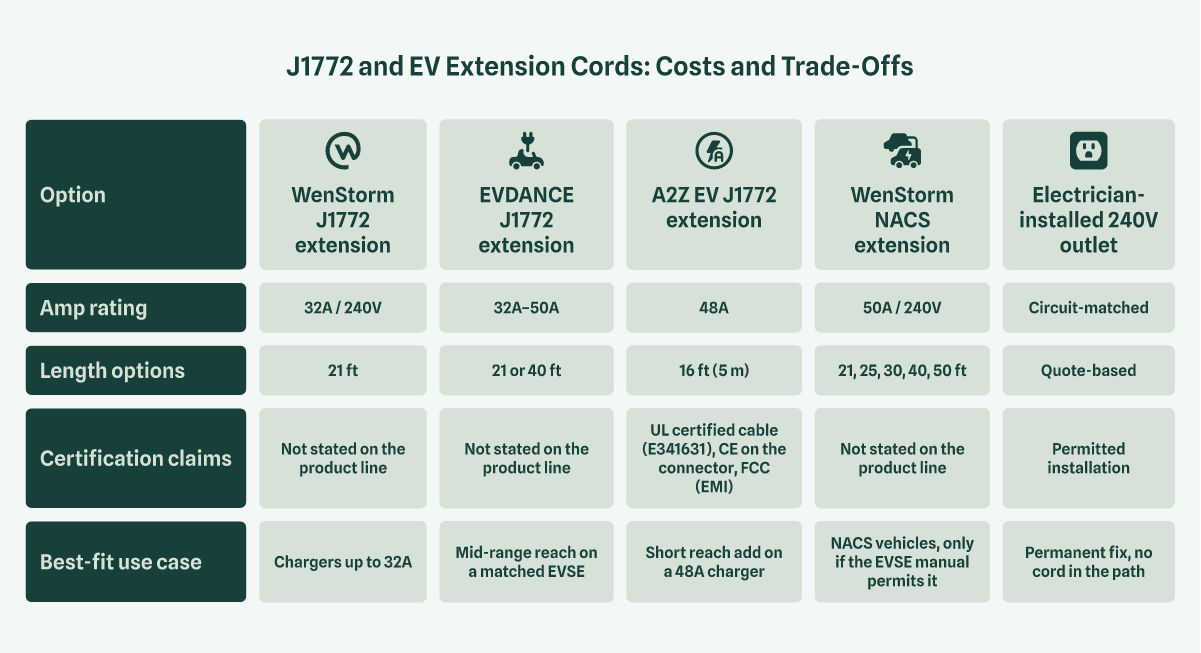
WenStorm prints the clearest warning of the group on its 32A cord: “Chargers up to 32A. Not 40A or 48A.” That single line explains why rating matching isn’t optional. A 40A EVSE on that cord pushes current through conductors sized for less.
Extension cords for EV charging trade cost, voltage drop and heat against length. A longer, higher-amp cord costs more and runs hotter. Buy the shortest length that solves your reach problem, not the longest you can afford.
One caveat sits outside the table. Extensions are vehicle-side accessories. Some manufacturers only permit a vehicle-side extension if the EVSE documentation expressly allows it, and Tesla’s Wall Connector documentation is the example to check. Read your EVSE manual before you buy anything. If it’s silent or says no, the electrician route is the honest answer. That one is quote-based rather than fixed.
Recommendations by Situation
Garage and driveway reach gaps
Match the extension to your EVSE’s amp output. Don’t grab the biggest cord on the shelf. Not 40A or 48A.” That single line is the whole discipline. If your charger is 40A, that cord isn’t for you.
For a typical two-car garage, buy 21 to 30 ft. WenStorm’s own length guidance maps 30 ft to home garage charging and reserves 50 ft for long-distance or RV setups. A longer cable means more voltage drop and more heat for no benefit you can use.
If 30 ft doesn’t reach, don’t stack two cords. Step to 40 or 50 ft in the correct amp rating, or move the outlet. Kelley Blue Book’s guidance is blunt on that point: “Hire a qualified electrician to install a dedicated 240-volt outlet closer to the EV’s charging port.”
Renters, camping and travel
A short certified extension plus a portable Level 2 charger is the combination I would buy for rental parking, trailer towing or an Airbnb stay. WenStorm pairs a 32A portable charger with a 21 ft extension for RV parks and cabins. The same 21 ft figure appears in its guest charging kit for hosts.
Keep the total run short. Every added foot is a connection point and a heat path when you are plugging into unfamiliar wiring.
When the usual answer doesn’t apply
If your vehicle has a NACS inlet and your charger is J1772, an extension cord won’t fix anything. You need an adapter, not distance. A cord swap only makes sense when you are replacing the EVSE’s own output connector.
Check your EVSE manual before buying anything. WenStorm lists the Tesla Wall Connector as permitting a NACS extension only if Tesla expressly allows a vehicle-side extension in the documentation. Some manufacturers prohibit it outright.
FAQ
Is a J1772 extension cable safe?
Conditionally, yes. AutoEdgeView puts the condition plainly: the cord needs to be 12 AWG or thicker (10 AWG for runs over 25 feet), rated for 15A minimum, outdoor-rated with an SJTW jacket, and kept under 50 feet. J1772 covers the connector itself. It says nothing about the cord you add between charger and car, which makes that extension the unregulated link in the chain. Certification is your filter here. Nexway says a high quality J1772 extension cord must carry UL, CE or TUV certification, and it flags overload, over temperature and short circuit protection as the features worth checking. I wouldn’t buy an uncertified one.
Is J1772 being discontinued?
No. SAE published J1772_202401 as a Current Standard on 2024-01-22. The rationale describes updates that refine the language, better define the AC connector dimensions, address Y-capacitor limitations from supporting charging up to 1000V, and harmonize with IEC 61851 and ISO 15118. A standard under active revision isn’t a standard being retired. The confusion comes from NACS becoming the North American port on new cars. J1772 remains the AC connector on the charger side for a large installed base, and the EPRI standards guidebook still centers on it. I’d plan around J1772 for years yet.
Which J1772 extension cable is the best?
There’s no single best, because the right cable is the one rated at or above your charger’s output. WenStorm sells a J1772 cable in 32A and 50A versions. Its own table warns that the 32A model is for “Chargers up to 32A. Not 40A or 48A.” A2Z EV rates its J1772 to J1772 cord at 48A with 16 ft of reach, and lists UL certified cable, CE certification on the connector and FCC certification. My pick for a 40A or 48A charger is the higher-rated cord, not the cheaper 32A one. Match the amp rating first. Then compare length and certification.
Can I use an extension cord for EV charging?
Don’t use a household extension cord. Kelley Blue Book says exactly that, and it recommends hiring a qualified electrician to install a dedicated 240 volt outlet closer to the EV’s charging port instead. A J1772 extension cable is a different product. It carries the J1772 connector on both ends and is built for the current. A general purpose cord isn’t. If the run is long enough that you’re reaching for a hardware store cord, the better fix is moving the outlet. I’d treat any regular extension cord on a Level 2 charger as a no.
Does anyone have a guide to buying EV charging extension cables for a j1772?
Yes, and the Nexway SAE J1772 extension cord application guide is the closest thing to a buying guide. It walks through interface design, conductor and insulation quality, and waterproof and dustproof ratings. Current capacity it lists as commonly 16A, 32A or 40A, with the advice to choose according to the power of the charging pile and vehicle demand. For the certification side, the EPRI standards guidebook names UL 2251, UL 2594, UL 2263 and UL 2231-1 and -2. Read the amp rating on your charger first, then buy a cord rated at or above it.
Sources
- J1772_202401 : SAE Electric Vehicle and Plug-in Hybrid Electric Vehicle Conductive Charge Coupler - SAE International
- An Electric Vehicle Charging Standards Guidebook for North America
- SAE J1772 Charging Interface Development, Troubleshooting and Extension Cord Application Guide
- EV Extension Cords & Cables | J1772 & NACS – WenStorm
- J1772 to J1772 Extension Cord | AC - A2Z EV
- SURFACE VEHICLE RECOMMENDED PRACTICE
- EVDANCE J1772 EV Extension Cord 32A-50A 21/40 FT
- Charging an EV? Don’t Use an Extension Cord - Kelley Blue Book