Disclosure: The Juice Index is reader-supported. If you buy through links on this page, we may earn a commission at no extra cost to you.
Most drivers don’t need an 80 amp EV charger. You need one only if your car’s onboard charger accepts more than 48 amps, and most EVs don’t.
An 80 amp charger is the highest single-port residential rating you can buy, per EV Charger Index, and it needs a 100 amp circuit. That’s a big electrical ask for a car that may never draw the power. Below I cover how amperage and kilowatts relate, what each size actually delivers, the wiring and panel limits, the mistakes buyers make, and which cars justify the upgrade.
The Direct Answer: Who an 80 Amp Charger Is Actually For
An 80 amp EV charger is only worth buying if your car’s onboard charger accepts more than 48 amps. Most EVs don’t, so most drivers don’t need one.
The EPA is blunt about this. “If you own a PEV with a 30-amp charging limit, it doesn’t benefit from using a charger that can supply 80 amps.” The same logic scales up. ChargeCalcs puts it plainly: an 80-amp charger could supply 19.2 kW, “but the onboard charger accepts at most 11.5 kW, so delivered power is the lower figure of 11.5 kW.” The car is the ceiling, not the wall unit.
Who should actually buy one
High-performance EVs and large-battery trucks that can accept the full 19.2 kW. FLO describes the payoff: with a 50-amp charger, going from 20-80% might take around 10.5 hours. On an 80-amp charger, about 6.5 hours. For a big truck battery, that gap is the whole point.
The cost of entry
An 80-amp charger requires a 100-amp circuit, and FLO notes many homes may not be equipped for one. That means a panel upgrade, a subpanel, or a load calculation before you buy anything.
The market reality
80A is the highest single-port residential rating available. Only 39 of 244 models in one tracking database offer it. It’s a niche product for a niche car.
If your EV tops out below 48 amps, skip the 80-amp unit. A 32 amp charger covers the same miles overnight for less money and simpler wiring.
How 80 Amp Charging Works, in Plain Language
A charger’s rating is a ceiling, not a promise. Level 2 chargers are rated between 16-80 amps, according to the EPA. Amps and kilowatts are just two ways of expressing the same rate of energy flow. A kilowatt is 1,000 watts. Higher amps at a given voltage means more kilowatts, and more kilowatts means faster charging.
In the United States, Level 2 chargers generally provide 240 volts. Multiply amps by volts and you get watts. So 80 amps times 240 volts comes to 19.2 kW. FLO describes an 80-amp home charger as providing a 19.2 kW output, the maximum charging capacity for vehicles that can handle it.
That last clause is the whole story. The charger is only half the circuit. Your car’s onboard charger has its own limit, and it takes the lower of the two figures. ChargeCalcs puts it plainly: “At 240 volts an 80-amp charger could supply 80 times 240, or 19.2 kW, but the onboard charger accepts at most 11.5 kW, so delivered power is the lower figure of 11.5 kW.” If your car caps at 11.5 kW, a 19.2 kW charger delivers 11.5 kW. You paid for headroom you can’t use.
Why the breaker is bigger than the charger
The National Electrical Code requires the circuit breaker to be sized at least 125% of the charger it feeds, per the EPA. Run the same math on 80 amps and you need a 100-amp circuit. FLO notes many homes may not be equipped for that.
If your panel can’t take a 100-amp circuit, the usual answer doesn’t apply to you. The fix isn’t a bigger charger. It’s a smaller one that fits the service you already have.
The Numbers: Amps, kW, Circuit Size and Charge Times
Level 2 charging runs on a simple ratio. At 240 volts, amps times volts gives you kW, so a higher amp rating always means a faster charge. The EPA puts Level 2 chargers between 16 and 80 amps, with 30 to 40 amps being more common (F1, F123).
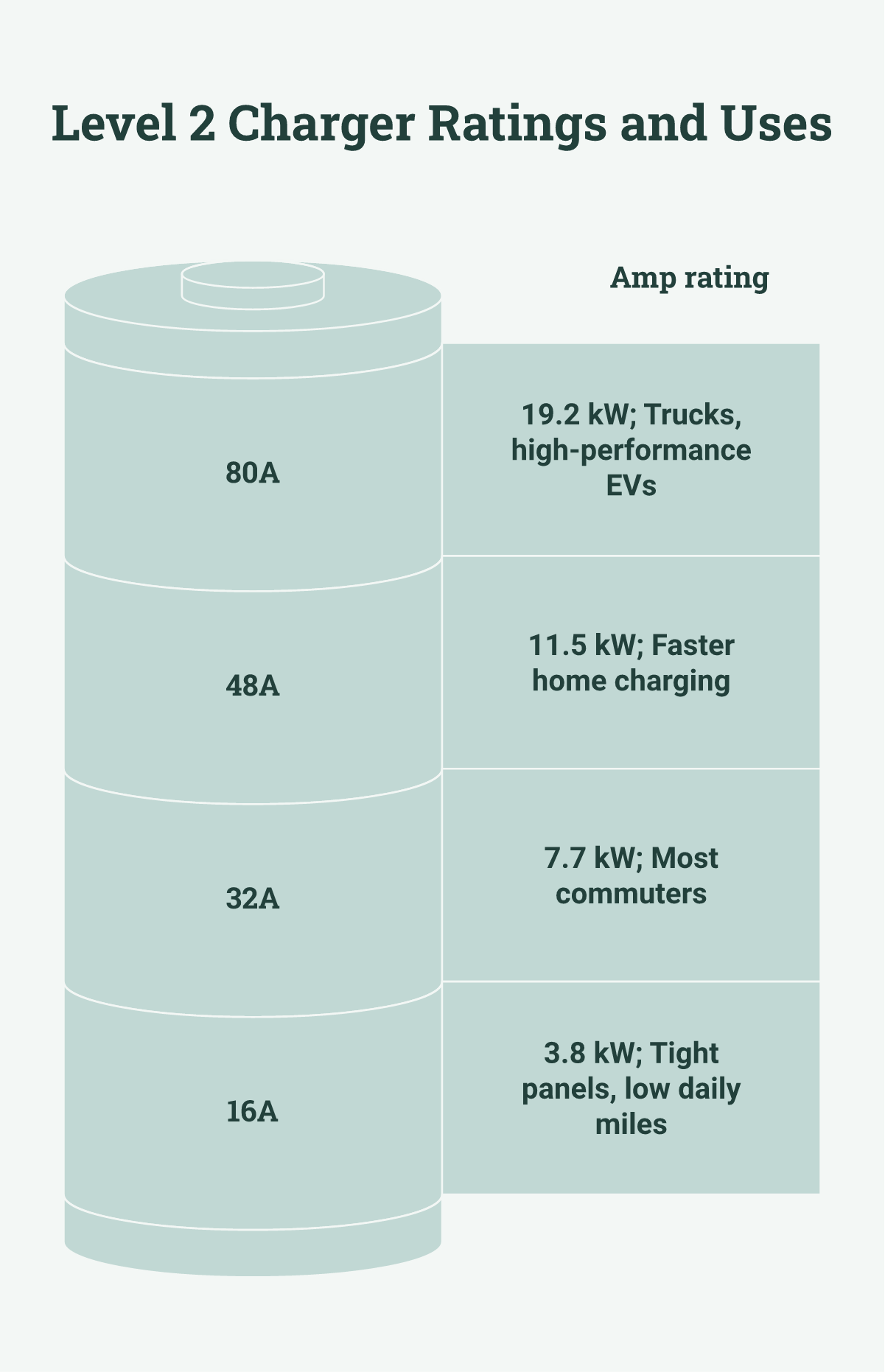
| Charger | Output | Circuit needed | Typical use |
|---|---|---|---|
| 16A | 3.8 kW | 20A | Tight panels, low daily miles |
| 32A | 7.7 kW | 40A | Most commuters |
| 48A | 11.5 kW | 60A | Faster home charging |
| 80A | 19.2 kW | 100A | Trucks, high-performance EVs |
Circuit size follows the 125% rule. A 40-amp charger needs a dedicated 50-amp circuit (F3). Enphase frames the same math another way: a 6.6 kW charger needs a dedicated 40 A circuit charging at 32 A (F154).
Range per hour tells the story better. Level 1 gives about 1.3 to 2.4 kW, or 3 to 5 miles of range per hour. Most Level 2 chargers give 7 to 12 kW, up to 40 miles per hour. An 80-amp unit gives 19.2 kW (F93, F117, F64).
Time is the real payoff. FLO’s example: 20 to 80% takes around 10.5 hours on a 50-amp charger versus about 6.5 hours on an 80-amp charger (F96). If your car caps its onboard charger below that, my advice is to skip the 80-amp circuit entirely and put the money into a 48-amp hardwired setup instead.
Common Mistakes and Installation Realities
Buying capacity your car can’t accept
People buy an 80 amp charger for a car that will never draw it. The EPA is blunt about this: “If you own a PEV with a 30-amp charging limit, it doesn’t benefit from using a charger that can supply 80 amps.” That’s a direct quote from the EPA’s charging guide. The charger is a supply. The car decides the draw. If your onboard charger maxes out far below 80 amps, the extra capacity sits idle every night.
Assuming the outlet works
A NEMA 14-50 outlet is a common choice for Level 2 EV chargers per the EPA. But it’s not the answer at 80 amps. The EPA notes that for chargers rated at 48 amps or higher, they are usually required to be hardwired instead of plugged into an outlet. Leviton’s EV800 confirms this in its own spec sheet. The unit is listed as “HARDWIRED ONLY.” If you planned on a plug-in setup, that plan ends at 48 amps.
Skipping the panel check
Before you buy anything, look at your electrical panel. The EPA says that if your home has at least 200 amps and two empty slots for a double-pole circuit breaker, you likely have capacity for a Level 2 charger. It also notes that even 100 amp service is often sufficient, depending on how much electricity your other appliances use. That second point matters. An 80 amp charger needs a 100 amp circuit, which can eat most of a 100 amp service on its own.
The fallback people ignore
If your panel is tight, the EPA suggests a 16 amp Level 2 charger might perfectly suit your needs. I think that advice gets dismissed too quickly. A 16 amp charger on a 240 volt circuit still beats a standard wall outlet for daily commuting. The common advice is to upgrade the panel and go big. My take is that a panel upgrade is a major expense, and a smaller charger is often the smarter first move. Run the smaller unit for a year. If it covers your driving, you saved the upgrade entirely.
Which 80 Amp Charger to Buy
The Grizzl-E Ultimate (80 A) leads this shortlist as the cheapest 80A model with a verified price, per EV Charger Index. The Enphase IQ EV Charger 2 and the Autel MaxiCharger 80A 19.2kW Residential round it out. All three carry a verified 80 amp output.
Here’s the spread. Same 19.2 kW output, wildly different prices. I wouldn’t pay the top of that band for amperage alone.
Want app control in the same 80-amp line? The Leviton EV80W is the Wi-Fi version, and it works with the My Leviton app. The EV800 is the standard unit.
Before you buy any of them, confirm your car actually accepts more than 48 amps. If it doesn’t, the extra spend buys nothing. My pick for most people in that situation is a 48-amp or 32 amp unit instead. That runs against the “buy the biggest charger now” line you’ll hear. I’d still give it. The 80-amp hardware only pays off when the onboard charger can use it.
A note on the Reddit question
“80a home chargers - which one should I buy?” depends on your panel, not the model. An 80-amp charger needs a 100-amp circuit. If your panel can’t carry that, no pick on this list helps.
FAQ
Is 80 amp enough for an EV charger?
An 80 amp charger is the most powerful home EV charging option available, so it’s more than enough for the circuit. The limit sits in the car, not the wall. The EPA notes that “Level 2 chargers are rated between 16-80 amps,” and every vehicle also has an advertised maximum level 2 charging rate. If you own a PEV with a 30-amp charging limit, it doesn’t benefit from a charger that can supply 80 amps. An 80-amp unit only pays off if your onboard charger accepts that much current.
What size wire should I use for an 80A EV charger?
The wire size follows the circuit, not the charger label. An 80-amp charger needs a 100-amp circuit. FLO states that “an 80-amp charger requires a 100-amp circuit, and many homes may not be equipped for this.” The EPA’s rule is that the circuit breaker is sized at least 125% of the charger it’s attached to. For an 80-amp unit, that math gives 100 amps. Wire gauge for a 100-amp run is an electrician’s call, and the NEC governs it. I wouldn’t guess at it.
How many amps is a typical EV charger?
Most home Level 2 chargers run well below 80 amps. The EPA reports that Level 2 output “typically range[s] from 16 to 80 amps, with 30 to 40 amps being more common.” FLO puts the common band at 30-50 amps with a 7-12 kW output. Many homeowners pick chargers in the 40-50 amp range, which gives you a decent balance between speed and cost. Think of 80 amps as the top of the range, not the middle. Still sizing your setup? The 32 amp EV charger guide covers where most drivers actually land.
Which EV charger would you get from this list?
I’d start with the Leviton EV800 or its Wi-Fi twin, the EV80W. Both carry a verified 80-amp output, and Leviton publishes the full spec sheet. The EV800 is hardwired only, runs on 208/240 VAC, and lists a 100 A breaker and 19.2 kW output. The catch is the 18-foot cord, shorter than some rivals. If cord length matters more to you, the Grizzl-E Ultimate and Enphase IQ EV Charger 2 both list 25 feet. My pick stays with Leviton for the documentation, not the bragging rights.
What is the current thinking on charging to 80 vs 100?
The 80 vs 100 question is about battery state of charge, not charger amperage. People mix the two up constantly. Nothing in the sources here sets a daily charge limit, so I won’t hand you one. What the EPA does say is that an 80-amp charger delivers 19.2 kW, and that a vehicle’s onboard charger caps what it accepts. A car limited to 11.5 kW draws 11.5 kW no matter what the wall can supply. Buy the charger for the car you have, not the number on the box.
Sources
- Plug-in Electric Vehicle Charging: The Details | US EPA
- EV800 | Products
- Is an 80-amp EV home charger right for you? | FLO
- Is an 80-amp EV home charger right for you? | FLO
- Getting Started with Home EV Charging | US EPA
- 80A EV chargers compared: 15 models with verified prices
- EV charging and solar | Enphase
- EV80W | Products