Disclosure: The Juice Index is reader-supported. If you buy through links on this page, we may earn a commission at no extra cost to you.
A 32 amp EV charger hits a hard ceiling set by math. On a 240V circuit it puts out 7.68 kW, which works out to roughly 20 to 25 miles of range per hour. That range depends on your car’s onboard charger efficiency.
Every model in this class lands on the same figure. ChargeCompared put it plainly: “All three chargers deliver the same power (7.68 kW) when running at 32A on 240V.”
So you’re really shopping for wiring, portability and price. Speed isn’t on the table. I cover what matters in the specs, what each tier costs, picks by use case, and what to skip.
What actually matters: the 5 specs that decide a 32 amp EV charger
Output math
A 32 amp EV charger on a 240 volt circuit delivers 7.68 kW. Every model in this class lands on that figure. ChargeCompared put it plainly: “All three chargers deliver the same power (7.68 kW) when running at 32A on 240V.” Power is the one thing you can’t shop for here.
Circuit requirement
NEC treats EV charging as a continuous load, so a 32A unit needs a 40A breaker. The database at EV Charger Index defines the category exactly that way, every model with a verified 32 amp output “which needs a 40 amp circuit under the NEC continuous-load rule.”
ChargeCompared called this correctly: “A 32A charger is almost always a panel decision, not a preference.” If your service can’t feed a dedicated 40A circuit, no charger choice fixes that. Check your panel first.
Wiring
Run 8 AWG copper on a dedicated 40 amp circuit. WireRef states it directly: “Wiring an ev charger level 2 (240v, 32a) correctly means running 8 AWG copper on a dedicated 40-amp circuit.” Don’t let anyone downsize this.
Vehicle ceiling
Many vehicles built before 2020 have an onboard charger that accepts 32A but not more. ChargeCompared notes 32A is “actually the ceiling for those cars.” For those drivers, 32A is the car’s limit, not the charger’s.
Form factor and control
Portable versus hardwired. Fixed versus adjustable, by dip switch, dial or app. Cord length matters too. A Grizzl-E Classic gets set at the dip switches.
Speed: what 32 amps actually delivers
A 32 amp EV charger puts about 7.68 kW into the car. ChargeCompared’s guide states that on a 240V circuit a 32 amp charger delivers 7.68 kW, which “translates to roughly 20 to 25 miles of range per hour depending on the EV’s onboard charger efficiency.” That spread is the car’s doing, not the charger’s. Two EVs on the same unit can add range at different rates.
The overnight math is simple. ChargeCompared says “an overnight charge (8 to 10 hours) covers your round-trip commute plus a buffer.” Assume a 40 mile round trip. Eight hours at 20 miles per hour adds 160 miles. Ten hours at 25 miles per hour adds 250. Either way you leave with far more than you burned.
Is 32 amps fast?
Not in the way a public fast charger is. This is Level 2 home speed. You park overnight, and a 32 amp unit does that job well. It won’t help if you arrive nearly empty and need to leave within the hour.
Should you upgrade to 40 amps?
Only if your car’s onboard charger accepts more than 32A and your panel can feed a bigger circuit. WattSimple’s sizing guide notes 48A “only pays off if your vehicle’s onboard charger can actually accept 48A (many top out at 32A or 40A) and your panel can supply a 60A circuit.” The same logic applies one tier down.
My take: skip the 40A upgrade unless you know your onboard charger’s limit. The common advice says to size up for futureproofing. You end up paying an electrician for amperage your car can’t accept.
Spec table across price tiers
Every charger in this category delivers the same 7.68 kW at 32A on 240V. The specs barely move. The price does. That spread buys convenience, control and build, not speed.
Budget tier
Both are portable units.
One caveat. These plug into a NEMA 14-50 outlet, so you still need a 40 amp circuit behind it. The charger is cheap. The circuit isn’t.
Mid tier
Most buyers land here.
The EVDANCE pair earns its premium over the WenStorm with a cleaner connector choice. If you own a Tesla, the Mobile Connector is the safest pick because the handshake is native.
Upper tier
The ChargePoint Home Flex costs about the same but adjusts from 16-50A. The Emporia Classic adjusts from 16-48A and sits slightly cheaper.
Here is my honest read, and it runs against what most guides tell you. I would skip the adjustable chargers unless you already know your next car accepts more than 32A. You pay a premium for headroom you may never use. Fixed units are simpler to install and there’s less to go wrong.
Wallbox tier
The Leviton EV320 is hardwired only, 18 ft cord, 7.6 kW output, NEMA 3R enclosure, Energy Star certified, and it requires a 40 amp breaker. It costs more than the portables. What you get is a permanent outdoor-rated box with no outlet to wear out.
Picks by use case
If you need to carry it
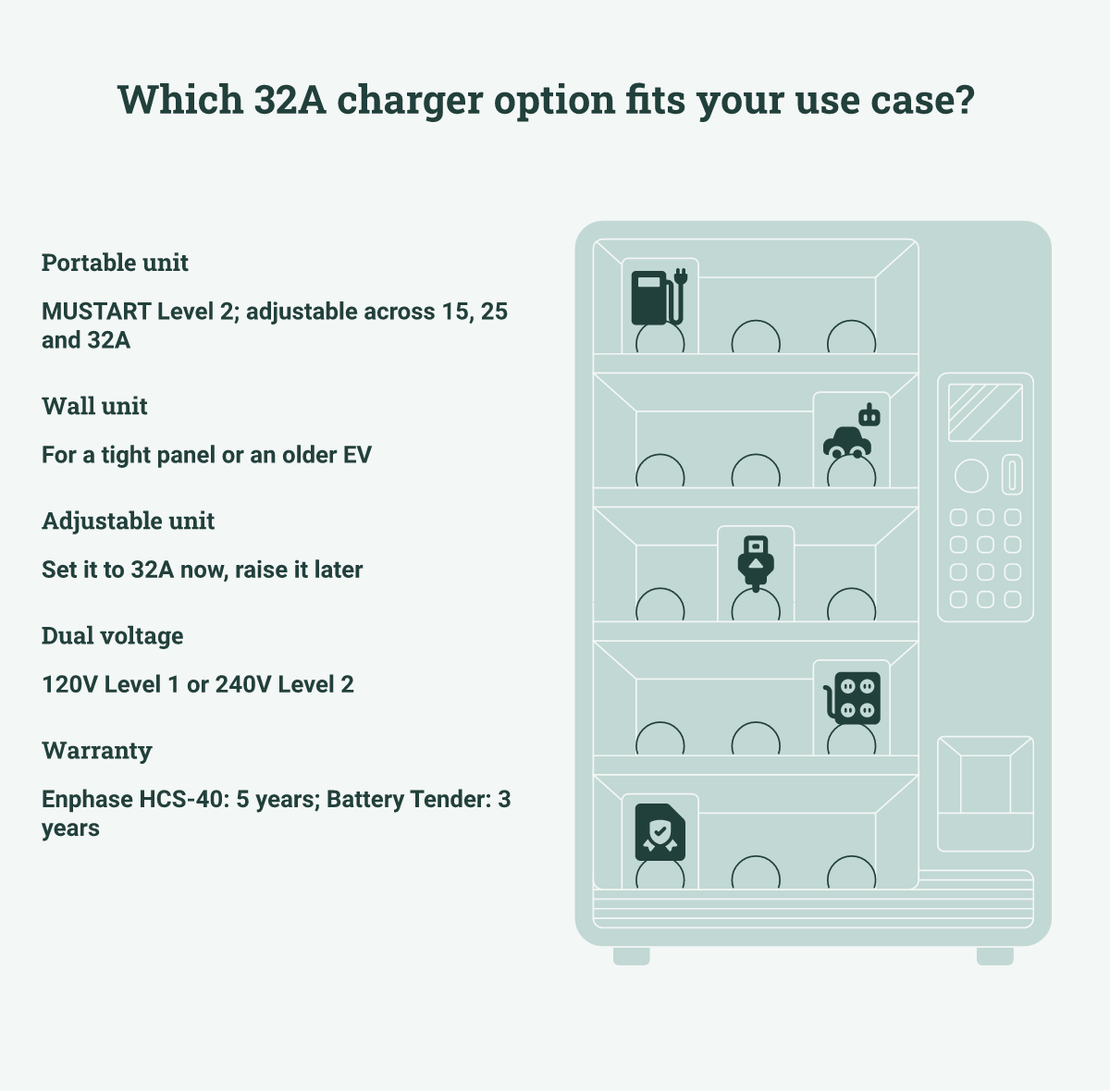
A portable 32A unit running from any 240V NEMA 14-50 outlet is the pick when the car has to travel with the cable. The MUSTART Level 2 is adjustable across 15, 25 and 32A with a 25 ft cord. That adjustability matters more than it sounds, because a 15A setting will run from a weaker outlet when the full 32A isn’t available. My view is that cord length beats app features in this class. A 25 ft cord reaches the port on a car parked nose-in. No app fixes a cable that is too short.
Tight panel or an older EV
If your panel is near its limit or your car predates 2020, the wall unit is the answer. Many vehicles built before 2020 have an onboard charger that accepts 32A but not more, so 32A is the car’s ceiling, not the charger’s. A 32-amp charger on a 240V circuit is the sweet spot for older EVs and tight electrical panels, per ChargeCompared. Set the dip switches to 32A and forget it.
You will hear that you should buy 48A now to future-proof. I would skip that. It only pays off if the onboard charger accepts 48A and the panel can supply a 60A circuit, according to WattSimple. Otherwise the extra capacity sits idle.
Set it to 32A now, raise it later
An adjustable unit covers both cases. Buy one, dial it to 32A for today’s circuit, then raise the setting when a faster-charging EV arrives.
Dual voltage
The Battery Tender eCharge 32 Amp Level 1+2 is the flexible option. Battery Tender says it operates at 120V Level 1 from any standard outlet or switches to 240V Level 2 for full-speed charging at home.
Warranty
For coverage, the Enphase HCS-40 Ruggedized carries 5 years, the longest in the class per EV Charger Index. The Battery Tender eCharge 32A runs 3 years.
What to skip
Skip anything without a verified 32A output
The category has a definition, not a vibe. It covers every model with a verified 32 amp output, which needs a 40 amp circuit under the NEC continuous-load rule, and 30 of the 244 models in the evchargerindex.com database qualify. If a listing doesn’t state a 32A output in writing, treat the claim as decoration. Same logic for a “40A” or “48A” unit you never plan to run above 32A.
Skip unbranded marketplace listings
The reader question about 32A Level 2 chargers sold on eBay is the exact trap. No UL or ETL certification trail means no independent record of the enclosure, the cord or the ground-fault protection. A cheap listing isn’t a bargain when the hardware sits on a 40A circuit in your garage. Buy from a brand with published specs and a warranty page.
Skip 48A and 80A for “the future”
A bigger unit only pays off if your vehicle’s onboard charger can actually accept 48A, and many top out at 32A or 40A, per WattSimple. If your car caps at 32A, a 48A charger delivers the same miles per hour as the 32A unit. Buy the amperage your car accepts.
Skip the 22kW assumption
A 22kW charger can’t push more into a car whose onboard charger accepts less. The wall unit negotiates down. You pay for capacity you can’t use.
FAQ
How many miles per hour can a 40-amp EV charger charge an EV?
The fact sheet doesn’t give a miles-per-hour figure for a 40-amp charger, so I won’t supply one from memory. The closest verified figure is for 32 amps. ChargeCompared states that “All three chargers in this guide deliver the same wattage at 32A: 7.68 kW, or roughly 20 to 25 miles of range per hour.” A 40-amp unit on a 240V circuit puts out more power than that 7.68 kW ceiling, because 32 amps is the maximum a 40-amp breaker delivers under the NEC continuous-load rule.
Can I use a 22kW charger on a 7kW car?
Yes, and the car decides the rate. A charger doesn’t push power into the vehicle. The onboard charger in the car draws only what it can accept. ChargeCompared notes that “Many vehicles built before 2020 have an onboard charger that accepts 32A but not more,” and that “Older EVs and some vehicles with smaller batteries are specifically limited to 32A by their onboard charger, so 32A is actually the ceiling for those cars.” So a 22kW unit on a 7kW car will charge at the car’s limit, not the charger’s rating.
Is a 32W charger fast?
If you mean a 32-amp charger, it’s fast enough for overnight home charging. ChargeCompared states that “For daily use, this means an overnight charge (8 to 10 hours) covers your round-trip commute plus a buffer.” At 32A on a 240V circuit you get 7.68 kW, which is roughly 20 to 25 miles of range per hour. That’s Level 2 speed. It isn’t DC fast charging, and I wouldn’t expect it to top up a long trip in half an hour.
How many amps does an EV fast charger need?
It depends on which kind of fast you mean. The fact sheet only covers home hardware. For AC Level 2 charging, a 32A unit needs a 40A circuit under the NEC continuous-load rule, per the EV Charger Index definition. Leviton’s EV32W product page notes the station “is hardwired and requires a 40 Amp breaker.” For DC fast charging, the sources here give no amperage figure, so I’m not going to guess one.
Best 32 amp charger option?
I wouldn’t name one winner, because the sources disagree and the right pick depends on the circuit. The EV Charger Index reports MUSTART models as the cheapest verified 32A options, while ChargeCompared favors the portable bokman unit or the Grizzl-E Classic for wall mounting. EV Charger Lab names the Webasto Go as its top choice. All of them deliver the same 7.68 kW at 32A. My pick for most people is the wall unit with no app. As ChargeCompared puts it, a 32A charger “is almost always a panel decision, not a preference.”
Sources
- 32 Amp Level 2 Electric Vehicle Charging Station | Leviton | Products
- Best 32A EV Charger for Home Charging
- 32A EV chargers compared: 26 models with verified prices
- EV32W | Products
- EV Charger Breaker & Wire Sizing: The NEC 125% Rule | WattSimple
- Best 32-Amp EV Charger 2026: The Right Pick for a 40-Amp Circuit
- EV Charger Level 2 (240V, 32A) Circuit: Wire Size & Breaker
- EV Charger Circuit Wire Sizing Service Guide | NEC & IEC Examples